
NN 16/2026
LOOP VAN ‘N FYN LYN:
BESTUUR VAN KONFLIK TUSSEN LEDE
2026/06/12
WALKING THE LINE:
MANAGING CONFLICT BETWEEN MEMBERS
If you think teaching is all about chalkboards, lesson plans, and the occasional staffroom debate over missing tupperware, think again. Schools are workplaces, and like any workplace, conflict is an inevitable part of the environment. The real challenge begins when both sides of that conflict are members of the same union. Suddenly, the organisation which is meant to stand united finds itself carefully walking a legal and ethical tightrope.
This newsletter aims to set out the legal position of the SAOU when providing information and advice to its members in circumstances where two or more members are in conflict with one another.
These situations typically arise in the context of workplace grievances, disciplinary proceedings, harassment allegations, or other forms of employment-related disputes, and must be approached with careful regard to applicable labour legislation and constitutional principles.
The nature of the SAOU’s duty to members
In terms of the Labour Relations Act 66 of 1995 (LRA), a registered trade union has the right to represent its members in grievance and disciplinary proceedings and in dispute resolution forums such as the Commission for Conciliation, Mediation and Arbitration (CCMA) and relevant bargaining councils. This right is accompanied by a corresponding duty to act in a manner that is lawful, procedurally fair, and consistent with the principles of fair representation.
Although the LRA does not expressly codify a detailed duty of fair representation equivalent to that found in some other jurisdictions, South African courts have clearly recognised that trade unions must act in good faith, for a proper purpose, and in a manner that is not arbitrary, capricious, or discriminatory when representing their members. These principles are also informed by the constitutional right to fair labour practices as found in section 23 of the Constitution of the Republic of South Africa, 1996.
The legal and ethical risks associated with conflict between members
When two members of the SAOU are involved in a dispute with one another, the union is placed in a position of potential conflict of interest. For example, one member may be the complainant in a grievance or misconduct matter, while the other is the subject of the complaint.
In circumstances of this nature, the SAOU cannot fully advance the interests of one member without potentially prejudicing the other. If not properly managed, this may expose the SAOU to allegations that it has acted unfairly or has failed to discharge its duty of representation.
It is permissible, and often necessary, for the SAOU to provide general information to all members involved in such a dispute. This includes explaining workplace procedures, disciplinary codes, applicable collective agreements, and the operation of dispute resolution processes under the LRA. Providing this type of neutral, procedural guidance does not in itself give rise to a conflict.
However, greater caution is required when providing specific advice or representation. Where a clear conflict of interest exists, each member will be assisted by a different SAOU representative, for example a representative from the relevant Province and a representative from the Legal Services department. These representatives will then act independently, and appropriate internal measures are implemented to prevent the exchange of confidential information between them. This approach is consistent with general principles of natural justice and helps to safeguard the integrity of the SAOU’s processes.
In certain circumstances the union may lack the capacity to provide independent representation to each member (disputes involving multiple parties), or if the conflict is particularly acute, it may be necessary to advise one or both members to seek external representation. This may include referral to private legal practitioners or, where appropriate, allowing members to be represented by fellow employees in terms of workplace disciplinary codes or applicable collective agreements.
This is however not common practice, and the SAOU generally strives to find ways to support all its members as effectively as possible.
The aspect of confidentiality
Confidentiality is a critical obligation in this context. Information disclosed by one member must not be shared with another member without consent, unless required by law or necessary for the proper conduct of proceedings. A failure to maintain confidentiality may not only undermine trust in the union but could also expose it to legal claims, including potential disputes referred to the CCMA or Labour Court.
At an institutional level, the SAOU remains mindful of its obligation to act fairly and impartially. While we are entitled to support our members, we will avoid conduct that may reasonably be perceived as unjustifiably favouring one member over another in internal disputes. Importantly, the SAOU does not assume the role of an adjudicator; rather, its role is to ensure that all members receive appropriate representation and that fair procedures are followed in line with the LRA and applicable workplace policies.
In order to manage these issues effectively, the SAOU has adopted the necessary policy addressing formal conflict of interest and specifically dealing with disputes between members. This policy provides for early identification of conflicts, the allocation of separate representatives, and clear confidentiality protocols. SAOU officials are continuously trained on these requirements, and proper records are kept of all advice and representation provided. There are also certain guidelines in place for when external referrals are appropriate.
In conclusion, South African labour law permits the SAOU to provide information and advice to members who are in conflict with one another, but this is done in a manner that is consistent with the principles of fairness, good faith, and procedural justice embodied in the LRA and the Constitution. Conflicts of interest are carefully managed by the SAOU through a range of appropriate safeguards.
If you have doubts or questions on the matter, please do not hesitate to contact your provincial SAOU office or the SAOU Legal Department.
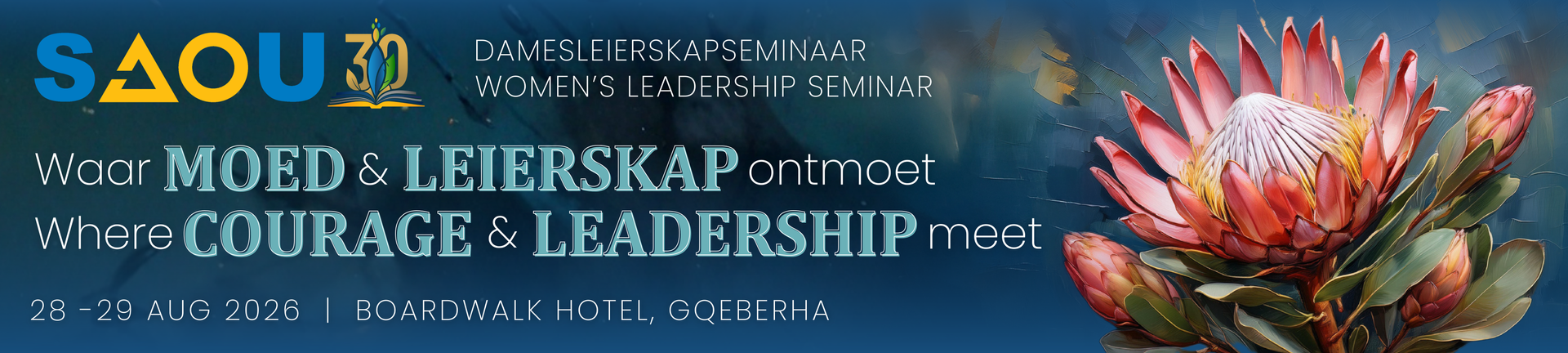
Damesleierskap-seminaar 2026
Dit is weer tyd vir die immergewilde damesleierskap-seminaar!
Leierskap gaan nie net oor bestuur nie; dit gaan oor die dapperheid om standvastig te bly wanneer dit die meeste saak maak. Ons nooi alle aspirant-damesleiers in die onderwys uit na 'n bemagtigende seminaar wat fokus op ons 2026-tema: Waar Moed en Leierskap Ontmoet.
Ware leierskap vereis die hart om te inspireer en die ruggraat om te besluit. Hierdie seminaar is ontwerp om jou te help om daardie gaping te oorbrug en jou potensiaal in 'n kragtige teenwoordigheid in jou skool en gemeenskap te omskep.
Datum: 28 - 29 Augustus 2026
Plek: Boardwalk Hotel en Konferensiesentrum, Gqeberha
WOMEN'S LEADERSHIP SEMINAR 2026
It's again time for the ever-popular women's leadership seminar!
Leadership is not just about management; it is about the courage to stand firm when it matters most. We invite all aspiring women leaders in education to an empowering seminar focused on our 2026 theme: Where Courage and Leadership Meet.
True leadership requires the heart to inspire and the backbone to decide. This seminar is designed to help you bridge that gap and transform your potential into a powerful presence in your school and community.
Date: 28 - 29 August 2026
Venue: Boardwalk Hotel and Conference Centre, Gqeberha

Hoofdesimposium 2026
Dis tyd om in te tree, jou posisie te verbeter en daardie leierskapspiere te laat bult! Ons nooi graag alle skoolhoofde en adjunkhoofde – beide mans en vroue – om by ons aan te sluit vir die krag-geleentheid van die jaar: Die 30ste SAOU Hoofdesimposium.
Leierskap is nie net 'n titel nie; dis 'n uithouvermoësport. Hierdie jaar fokus ons op die "swaar werk" van skoolbestuur, wat jou die strategie en stamina bied wat nodig is om jou skool na oorwinning te lei.
Die SAOU Hoofdesimposium 2026 beloof om, weereens, alle verwagtinge te oortref!
Datum: 30 Augustus – 2 September 2026
Plek: Boardwalk Hotel en Konferensiesentrum, Gqeberha
Registreer hier - daar is slegs beperkte plekke beskikbaar.
Principals' symposium 2026
It's time to step up, improve your position and flex those leadership muscles! We invite all principals and deputy principals – both male and female – to join us for this years power event: The 30th SAOU Principals Symposium.
Leadership is not just a title; it's an endurance sport. This year, we're focusing on the "heavy lifting" of school management, providing you with the strategy and stamina needed to lead your school to victory
The SAOU Principals’ Symposium 2026 promises to, once again, exceed all expectations!
Date: 30 August – 2 September 2026
Venue: Boardwalk Hotel and Conference Centre, Gqeberha
Register here - there are only limited places available.